What is cryptocurrency AML screening and why is it important?
But it also presents risks: coins can pass through exchanges, DeFi protocols, mixers, darknet markets or wallets linked to hacks.
That is why AML checks have become an important part of working safely with digital assets. They help determine whether a specific transaction, address or asset has links to suspicious sources.
In this article, we’ll look at what AML checks are, how they work, who needs them, how they differ from KYC, and how to check cryptocurrency before a transfer.
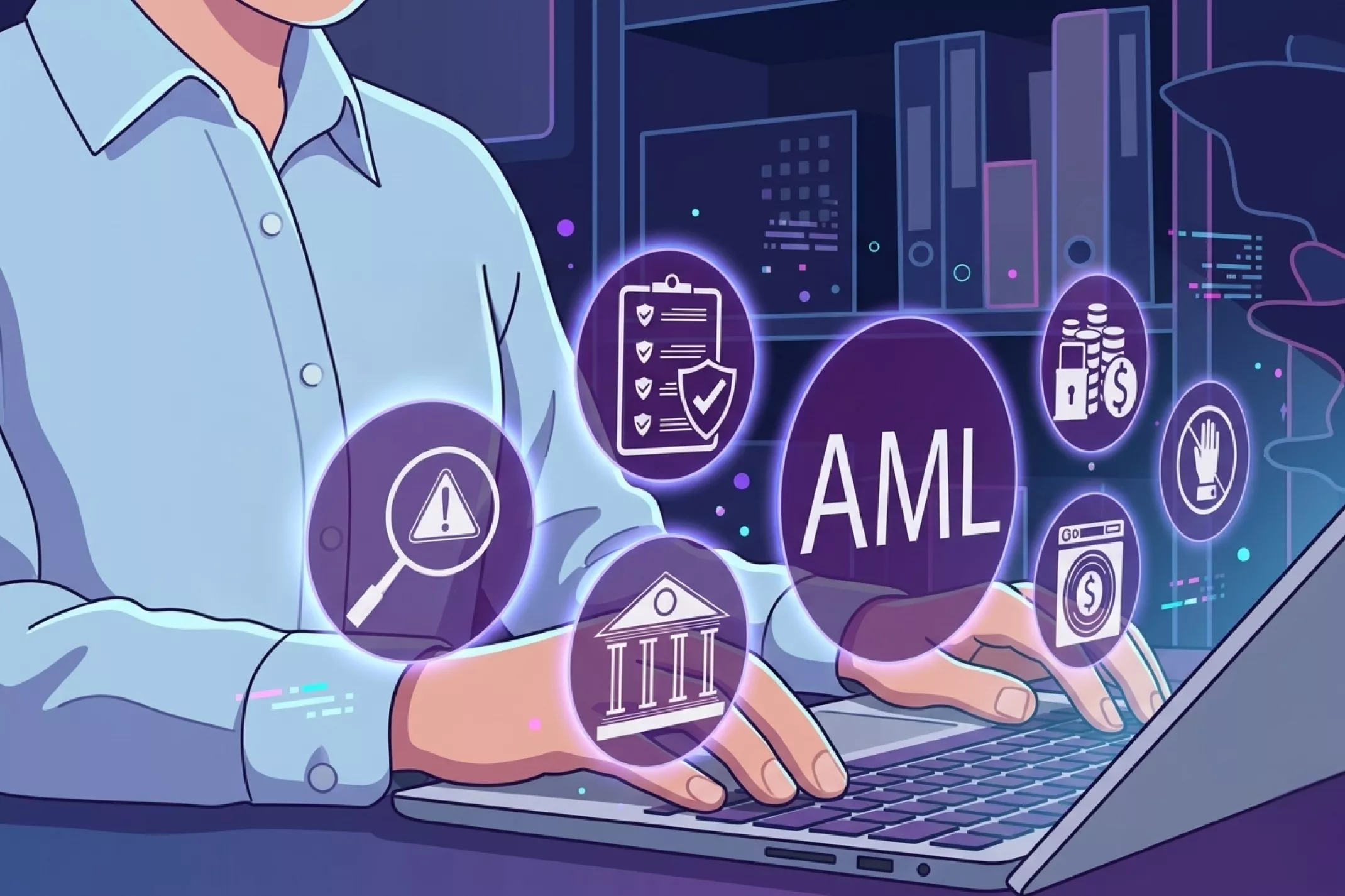
What is cryptocurrency AML verification and why is it important?
Cryptocurrency provides access to fast international transfers, investments and digital payments. However, its transparency does not mean there are no risks whatsoever. Every transaction has a history, and this history can influence whether an exchange will accept a deposit, whether a service will freeze funds, and whether additional questions will arise regarding the origin of the assets.
Cryptocurrency AML checks help to assess such risks in advance. It reveals whether funds have been linked to fraud, mixers, sanctioned addresses, the dark web, or other suspicious sources.
For businesses, it is a tool for compliance and reputation protection. For the average user, it is a way to reduce the risk of acquiring ‘dirty’ assets or having funds frozen.
What is an AML check
AML stands for Anti-Money Laundering. In cryptocurrency, this term refers to the process of analyzing digital assets, addresses, and transactions for potential risks.
Simply put, an AML check shows whether cryptocurrency may have been connected to illegal activity. For example, fraud, theft, sanctioned addresses, the darknet, terrorist financing, or the use of services designed to hide the origin of funds.
The international FATF organization states that AML/CFT requirements apply to virtual assets and virtual asset service providers. Such companies must use a risk-based approach, register or obtain licenses, and monitor the risks of money laundering and terrorist financing.
How it looks in practice
When a user sends cryptocurrency to an exchange, the platform can automatically check the sender’s address. If the system sees that the funds previously passed through risky sources, the transaction may receive an increased AML risk score.
This does not always mean that the user has broken the law. Sometimes risk appears because of the previous history of the coins. For example, assets may have moved many times between wallets, and part of their path may have been connected to a suspicious service.
Why an AML check for cryptocurrency has become important
Cryptocurrency transactions are public in most blockchains. However, address owners usually remain pseudonymous. This creates a paradox: the movement of funds is visible, but the user’s identity cannot always be established immediately.
This is where AML analysis of cryptocurrency is needed. It helps assess not the user’s identity, but the history of the asset. The system analyzes where the funds came from, which addresses they passed through, and whether any of those addresses were risky sources.
According to Chainalysis, in 2023, addresses linked to illicit activity sent approximately $22.2 billion worth of cryptocurrency to different services. This is less than in 2022, but the volume still shows why cryptocurrency checks remain relevant.
Main goals of an AML check
An AML check of a wallet or transaction usually has several goals:
to determine the source of the cryptocurrency;
to find links to risky addresses;
to assess the probability of funds being blocked on an exchange;
to reduce the risk of accepting “dirty” assets;
to help businesses meet compliance requirements.
This process is especially important for crypto exchanges, exchangers, payment services, OTC desks, and companies that accept cryptocurrency payments.
The key point
An AML check is not a “sentence” for an address or a user. It is a risk assessment tool. It helps understand how safe it is to accept or send a particular cryptocurrency.
How an AML check for cryptocurrency works
To understand how an AML check for cryptocurrency works, imagine the blockchain as an open transaction ledger. It shows which address the funds came from, where they were sent, and which intermediate addresses they passed through earlier. AML services analyze this chain and assign a certain risk level to a transaction or wallet.
Usually, the system does not look only at the latest operation. It analyzes the asset’s history several steps back. This makes it possible to identify indirect links to suspicious sources. For example, a user may receive cryptocurrency from a normal counterparty, but part of those funds may have previously passed through a high-risk service.
Which sources are considered risky
During AML analysis, the system compares addresses with databases and risk categories. The most common suspicious or high-risk sources include:
darknet markets;
mixers and services for hiding transaction traces;
addresses linked to hacks of exchanges or DeFi protocols;
fraudulent projects and phishing schemes;
sanctioned addresses;
illegal gambling platforms;
wallets with a history of extortion or ransomware.
It is important to understand that a connection to a risky source does not always mean a direct violation. The AML system assesses the probability of risk. The final decision depends on the policy of the exchange, service, or company performing the check.
What an AML system checks
A cryptocurrency check can include different parameters. Most often, the system analyzes a wallet address, a specific transaction, a token, or the amount that has arrived in an account.
An AML service evaluates not only the transfer itself, but also the context. Where did the funds come from? Were they split into many small parts? Did they pass through exchanges without KYC? Did they reach wallets that had already been marked as risky?
Main indicators of AML analysis
Indicator | What it means |
Risk score | Overall risk assessment of an address or transaction |
Sources of funds | Categories of addresses from which the cryptocurrency originates |
Risk percentage | Share of assets connected to suspicious sources |
Analysis depth | Number of previous transactions in the chain |
Risk type | For example, scam, mixer, darknet, or sanctioned address |
This approach helps not only identify problematic assets, but also better understand their history. For businesses, it is part of compliance. For private users, it is a way to reduce the risk of losing access to funds.
Check the risks before the deal
Buy and exchange cryptocurrency with Bitmore — fast, transparent, and safer for your assets.
AML wallet check: when it is needed
An AML wallet check is needed not only by large companies. It is useful for anyone who regularly receives or sends cryptocurrency. This is especially relevant for freelancers, traders, investors, online business owners, and people who work with P2P transfers.
For example, a user sells USDT through P2P and receives payment to their wallet. At first glance, everything looks normal. But if these USDT were previously connected to a fraudulent scheme, the exchange may send the transaction for additional review. In the worst case, the funds may be temporarily blocked.
That is why before large transfers, it is worth checking not only the amount and address, but also the reputation of the cryptocurrency. This is especially important for stablecoins, which are often used in international settlements, P2P deals, and business payments.
Typical situations for a check
An AML check is appropriate if you:
receive payment in cryptocurrency from a new counterparty;
buy assets through P2P;
transfer funds to a centralized exchange;
work with large amounts;
accept cryptocurrency as a business.
In such cases, a check helps you act more cautiously. It does not guarantee the complete absence of problems, but it significantly reduces the risk of unpleasant surprises.
How to check cryptocurrency before receiving or sending it
The question of how to check cryptocurrency becomes especially important before large transactions. One unsuccessful deposit can lead to frozen funds, additional requests from an exchange, or payment delays. Therefore, it is better to perform an AML check before the transaction, not after it.
The simplest scenario looks like this: the user receives a wallet address or transaction hash, inserts it into an AML service, and receives a report. The report usually shows the overall risk level, categories of fund sources, and the share of assets connected to suspicious addresses.
Basic check procedure
To run a cryptocurrency check, you do not need to be a technical specialist. It is enough to follow a few steps:
Copy the wallet address or transaction hash.
Choose a reliable AML service.
Start the analysis of the address or transfer.
Check the overall risk score.
See which sources form the risk.
Make a decision: accept the funds, reject the payment, or request an explanation.
This approach is especially useful in P2P deals. If you receive cryptocurrency from an unknown person, an AML check helps you avoid relying only on trust. It gives objective data about the asset’s history.
What to do if the risk is high
A high AML risk should not be ignored. If the report shows a connection to mixers, sanctioned addresses, fraudulent schemes, or the darknet, it is better not to rush into accepting the funds.
In this situation, you can:
ask the counterparty to explain the origin of the assets;
request another address for the transfer;
refuse the deal;
save the AML report for your own security;
contact exchange support or a legal consultant if the funds have already been received.
FATF, in its updates for the virtual asset sector, emphasizes a risk-based approach. This means that companies and services should not simply block everything automatically, but assess the specific risk level, context, and sources of funds.
How an AML check differs from KYC
AML and KYC are often mentioned together, but they are not the same thing. KYC stands for Know Your Customer. It is a procedure for identifying a person. An exchange may request a passport, selfie, proof of address, or other documents.
An AML check, by contrast, focuses on money. It analyzes not only the user, but also the origin of the assets. That is why a person can pass KYC but still receive questions about a specific transaction.
Simple comparison
Parameter | KYC | AML |
What it checks | User identity | Origin of funds |
Main goal | Customer identification | Financial risk assessment |
Where it is used | Exchanges, banks, fintech | Exchanges, exchangers, AML services |
Result | Verified profile | Risk score of an address or transaction |
In today’s crypto market, these processes complement each other. KYC helps a service understand who the client is. AML helps understand whether the funds the client works with are safe.
In the EU, transfers of crypto-assets are subject to regulation related to the Travel Rule. It requires the transfer of certain information about the sender and recipient during crypto transfers, and the relevant EBA guidelines have applied since December 30, 2024.
Protect your crypto operations
Choose a service where the exchange process is transparent, the rate is fixed, and support is available at every step.
Who needs an AML check
An AML check is not only needed by large exchanges. It is useful for anyone who wants to work with cryptocurrency without unnecessary risks. This is especially true when dealing with regular payments, large amounts, or unfamiliar counterparties.
For businesses, an AML check for cryptocurrency helps protect reputation. A company that accepts payments in digital assets must understand where the funds come from. This is important for accounting, tax reporting, banking partners, and internal control.
For private users, the benefit is also clear. If a person receives “dirty” assets, they may face problems during a later transfer to an exchange. The exchange does not always know the context of the deal. It sees the risky history of the coins and acts according to its own compliance rules.
When a check is especially important
Most often, an AML check should be performed before:
receiving payment for goods or services;
buying cryptocurrency through P2P;
transferring assets to a centralized exchange;
accepting large amounts from a new partner;
working with OTC deals.
In these cases, an AML wallet check works as a preliminary filter. It does not replace legal advice, but it helps make a more cautious decision.
Common mistakes during an AML check
Even a high-quality AML check will not be useful if its results are interpreted incorrectly. An AML report shows risks, but it does not always give a clear “yes” or “no” answer. That is why it is important to look not only at the overall percentage, but also at the sources of risk.
One common mistake is focusing only on the final score. For example, a 25% risk may look moderate. But if it is formed because of a sanctioned address or darknet market, this is a serious signal. In another case, the same percentage may be connected to an exchange without a clear KYC policy. Context matters.
Another mistake is checking cryptocurrency only after receiving the funds. In this case, the user effectively takes the risk upon themselves. If the assets turn out to be problematic, reversing the situation will be much harder.
What to pay attention to in the report
When analyzing the results, it is worth looking at several factors:
the type of risky source;
the percentage of connection to suspicious addresses;
the depth of the transaction chain;
the date of risky activity;
the policy of the exchange or service where the transfer is planned.
Not all risks are the same. A connection to a mixer, hack, or sanctioned address is usually more serious than an indirect connection to a low-transparency service. Therefore, AML analysis of cryptocurrency should be viewed as a decision-making tool, not as an automatic verdict.
How to reduce risks when working with cryptocurrency
An AML wallet check is only one element of security. To better protect your assets, you should combine it with basic financial caution.
Before receiving a large amount, it is worth checking the counterparty’s address. If you work with business payments, it is advisable to keep transaction history, invoices, correspondence, and AML reports. This can help explain the origin of funds if an exchange or bank asks additional questions.
For P2P operations, it is better to use trusted platforms, avoid accepting payments from suspicious accounts, and not agree to schemes where the counterparty asks to split a payment into many parts. Such actions may look suspicious to monitoring systems.
Practical rule
If you cannot explain the origin of the funds, it is better not to accept them. Cryptocurrency can move quickly between addresses, but its history remains visible on the blockchain.
Start with a safer exchange
Submit a request on Bitmore and buy or sell cryptocurrency with better risk control.
Conclusion
An AML check for cryptocurrency is a way to assess the risk of digital assets before receiving, transferring, or storing them. It shows whether funds are connected to suspicious sources, hacks, mixers, sanctioned addresses, or other undesirable categories.
For businesses, an AML check helps meet compliance requirements, protect reputation, and operate transparently. For ordinary users, it reduces the risk of a frozen deposit, problems with an exchange, or receiving assets with a dangerous history.
The short answer to the main question is this: an AML check is needed to understand the origin of cryptocurrency and assess how safe it is to work with it. It is not a formality, but a practical protection tool.
FAQ
What is an AML check for cryptocurrency?
An AML check for cryptocurrency is an analysis of an address, transaction, or asset for links to risky sources, including fraud, mixers, the darknet, or sanctioned addresses.
Why is an AML check for cryptocurrency needed?
It helps assess the origin of funds, reduce the risk of asset freezes, and avoid working with cryptocurrency that may have a suspicious history.
How does an AML check for cryptocurrency work?
The service analyzes the blockchain history of an address or transaction, compares it with databases of risky sources, and generates a risk score.
What does high AML risk mean?
High AML risk means that the cryptocurrency has a noticeable connection to suspicious or dangerous sources. Such funds may trigger additional checks.
Can a crypto wallet be checked before a transaction?
Yes. An AML wallet check allows you to assess the risk of an address before sending or receiving funds. This is especially useful for P2P and large amounts.
Does an ordinary cryptocurrency user need an AML check?
Yes. It helps avoid receiving risky assets, reduces the chance of exchange freezes, and makes crypto operations safer.