Blockchain Is - A Simple Explanation of a Complex Technology
In a world where digital technologies are developing at an incredible speed, the concept of “blockchain” is appearing more and more often in news, finance, and even everyday life. But what is blockchain really? Why does this technology attract so much interest and how can it change the future?
In this article, we will look at what blockchain is, how it works, why it is considered a revolutionary technology, and where it is used. You will get a simple and clear explanation even without a technical background.
What Is Blockchain In Simple Words
Let’s start with a basic definition.
Blockchain is a distributed database that stores information in the form of sequential blocks connected to each other using cryptographic methods.
In other words, blockchain technology is a way of storing data that: does not have a single control center, is transparent for all network participants, and is practically impossible to falsify.
Imagine a regular logbook that is simultaneously stored on thousands of computers around the world. Each new record is added only after confirmation by all participants.
A Simple Example For Understanding
Imagine that a group of people is maintaining a shared Google document. Everyone can see changes in real time. But: no one can change old records without others knowing, every change is recorded, everyone can see the edit history.
This is exactly how blockchain works - only much more secure and complex.
How Blockchain Technology Appeared
To understand what blockchain is, it is important to know its history.
Blockchain technology became known in 2008 when the concept of the cryptocurrency Bitcoin was published. The author (or group of authors) under the pseudonym Satoshi Nakamoto proposed a system that allows financial transactions without intermediaries.
The main idea was simple: to create a system that can be trusted without banks, to ensure transparency of transactions, to eliminate the possibility of fraud.
That is when blockchain technologies became the foundation of a new financial ecosystem.
How Blockchain Works
Now let’s move to the main point - how blockchain works.
At first glance, it may seem complicated, but if you break the process into steps, everything becomes clearer.
Basic Working Principle
Each operation in the network goes through several stages:
The user creates a transaction
The transaction is transmitted to the network
Other participants (nodes) verify it
The data is grouped into a block
The block is added to the chain
After that, it is almost impossible to change the information.
What Is a Block and a Chain
To better understand what blockchain technology is, you need to consider its components.
A block is a set of data (for example, a list of transactions)
A chain is a sequence of blocks connected to each other
Each block contains: data, the hash of the previous block, its own hash.
This creates a secure chain that cannot be falsified without changing the entire system.
Why Blockchain Is Considered Secure
One of the reasons why blockchain technologies have become so popular is the high level of security.
Main Reasons for Reliability
Data is not stored in one place
Each record is confirmed by the network
Cryptography is used
It is impossible to change old blocks without network consent
This means that the system does not have a “weak point” like traditional databases.
Decentralization - The Main Advantage
Another key point that explains what blockchain is - is decentralization.
In traditional systems: a bank controls transactions, a server stores data, one organization has full control.
In blockchain: there is no central authority, all participants are equal, decisions are made collectively.
This makes the system more transparent and resistant to attacks.
Where Blockchain Is Used Today
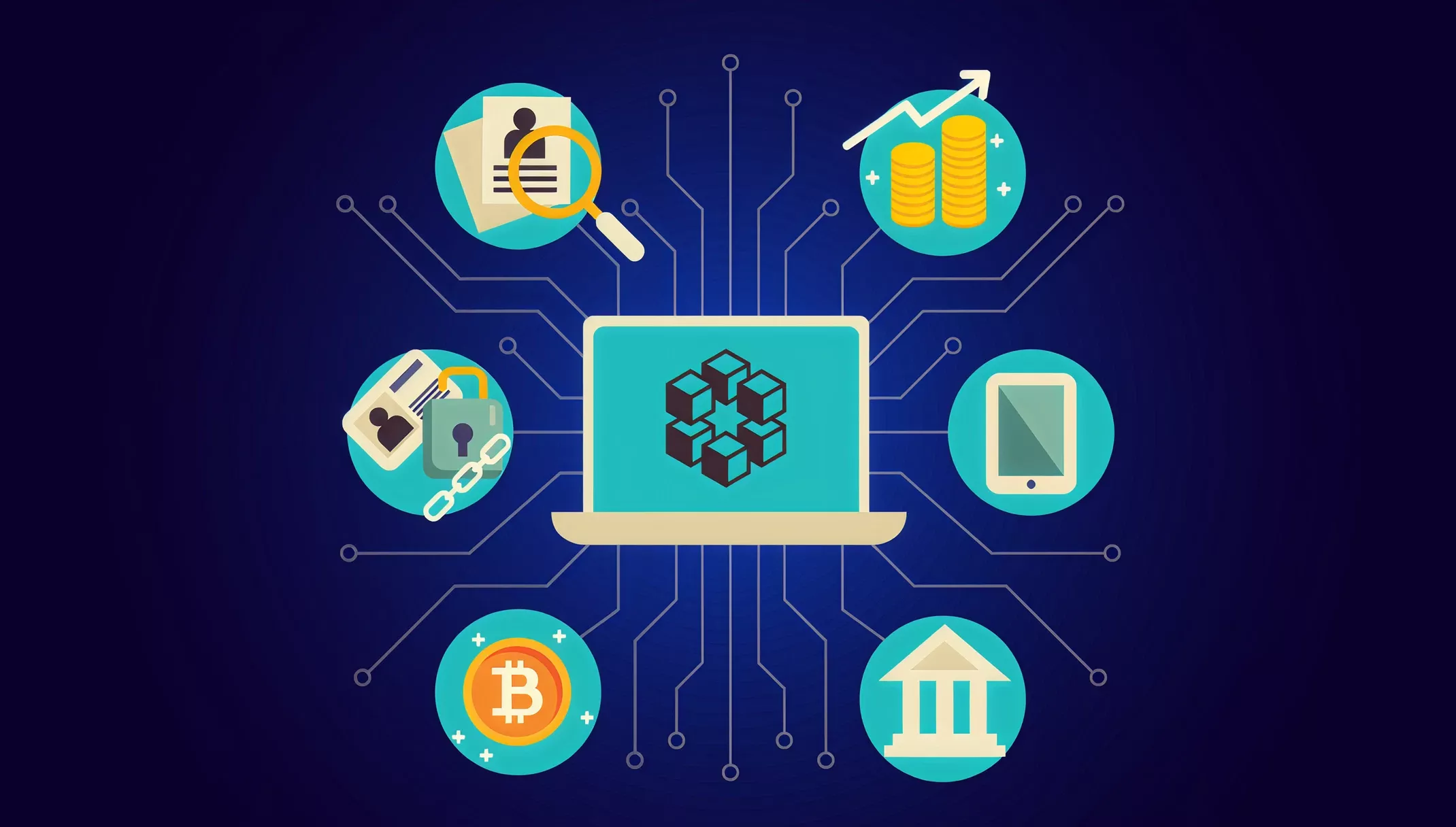
Although many associate blockchain only with cryptocurrencies, its applications are much broader.
Main Areas of Use
Finance (cryptocurrencies, payments)
Logistics (tracking goods)
Healthcare (storing patient data)
Voting (electronic elections)
Identification (digital passports)
This is just the beginning. New ways of using this technology appear every year.
Need a fast and convenient cryptocurrency exchange?
Why Blockchain Is the Future
The world is moving toward digital solutions. And here blockchain technology plays a key role.
It allows: to reduce costs, to increase security, to eliminate intermediaries, to speed up processes.
That is why large companies and governments are already actively exploring its potential.
Types of Blockchain and Their Features
After understanding the basic principles, it is logical to move on to the structure. After all, blockchain is not a single universal system, but a whole group of different approaches.
There are several types of blockchains, and each has its own purpose.
Public Blockchain
A public or open blockchain is a network accessible to everyone.
Anyone can: join the network, view transactions, participate in data validation.
This is the classic version used in cryptocurrencies.
Features: full transparency, high level of decentralization, open source code.
But there are also disadvantages - slowness and high network load.
Private Blockchain
A private blockchain is a closed system with access limited to a certain group of participants.
It is used by: companies, banks, and corporate systems.
Here: access is controlled, transactions are faster, resource costs are lower.
Thus, blockchain technologies are adapted to business needs.
Consortium Blockchain
This is a hybrid between public and private.
Control is distributed among several organizations. This approach is often used in: banking systems, logistics networks, and government projects.
This allows maintaining a balance between transparency and control.
Main Advantages and Disadvantages of Blockchain
To fully understand what blockchain is, it is important to evaluate it from different perspectives.
Advantages
Blockchain has a number of strong sides:
High level of security
Thanks to cryptography and a distributed system.Transparency
All transactions are available for verification.Immutability of data
Once recorded, information is almost impossible to change.No intermediaries
This reduces costs and speeds up processes.
Disadvantages
However, blockchain is not a perfect technology.
Main limitations:
Scalability
Networks may operate slowly under high load.High energy consumption
Especially in large networks.Complex implementation
Requires technical expertise.Regulatory uncertainty
In many countries there are still no clear rules.
How Blockchain Is Used in Real Life
Theory is good, but practice is even more important. Let’s look at where blockchain technology is already changing the world.
Financial Sector
The most obvious field is finance.
Blockchain allows:to make international transfers without banks, to reduce fees, to speed up transactions.
This is especially relevant for countries with unstable banking systems.
Logistics and Supply Chains
In logistics, it is important to know where a product is and what path it has taken.
Thanks to blockchain: each stage is recorded, data cannot be falsified, trust between partners increases.
Healthcare
In medicine, patient data must be: accurate, secure, accessible.
Blockchain technologies are a solution that allows storing medical information without the risk of loss or alteration.
Digital Identity
Today, the problem of personal data security is becoming increasingly relevant.
Blockchain allows: to create digital passports, to control access to data, to avoid information leaks.

Smart Contracts - The Next Level
Another important part of understanding how blockchain works is smart contracts.
Smart contracts are programs that automatically execute the terms of an agreement.
For example: you rent an apartment, money is transferred automatically after conditions are met, no intermediary is needed.
This opens new opportunities for: business, finance, legal processes.
How to Start Using Blockchain
For many users, the question sounds like this: if blockchain is already understood, how to start?
You can begin with simple steps:
Create a crypto wallet
Explore basic services
Learn security principles
Try small transactions
This will help you better understand how the system works in practice.
Need to exchange cryptocurrency quickly?
Why Businesses Choose Blockchain
More and more companies are integrating blockchain technologies into their processes.
The reasons are obvious:cost reduction, increased trust, process automation, data protection.
Blockchain is especially actively implemented by: financial institutions, IT companies, and logistics corporations.
What Are the Prospects of Blockchain
Technology continues to evolve.
It is expected that in the coming years: faster networks will appear, energy consumption will decrease, the number of applications will grow.
This means that blockchain technology will become even more accessible.
Myths About Blockchain That Should Be Debunked
Despite the popularity of the technology, there are still many misconceptions around it. To better understand what blockchain really is, it is worth examining the most common myths.
Myth 1: Blockchain Is Only About Cryptocurrencies
This is the most common misconception.
Yes, cryptocurrencies are the first application of blockchain. But blockchain technology is much more: data management, digital contracts, voting systems, cybersecurity.
Cryptocurrencies are just one of many areas.
Myth 2: Blockchain Is Completely Anonymous
In reality, this is not entirely true.
Most blockchain networks are pseudonymous: transactions are public, addresses are not tied to names, but activity can be tracked if needed.
Therefore, blockchain is a transparent system, not a completely anonymous one.
Myth 3: Blockchain Cannot Be Hacked
Although the system is very secure, it is not absolutely invulnerable.
There are risks: attacks on users, smart contract vulnerabilities, code errors.
That is, blockchain technologies are secure, but require proper use.
How Blockchain Differs from Traditional Databases
To fully understand what blockchain is, it is important to compare it with traditional systems.
Key Differences
Characteristic | Traditional database | Blockchain |
Control | Centralized | Decentralized |
Data modification | Possible | Practically impossible |
Transparency | Limited | High |
Security | Depends on server | Distributed |
Trust | Through intermediaries | Through algorithms |
This is the key reason why blockchain technologies are a revolution in the field of data.
When Blockchain Is Better Than Traditional Solutions
Blockchain is not always the optimal choice. But it is especially effective when:
transparency is required,
participants do not trust each other,
data immutability is important,
automation of agreements is needed.
In such cases, blockchain technology shows maximum efficiency.
How Blockchain Affects Different Industries
We are now witnessing the active implementation of technology in various sectors. This helps to better understand how blockchain works in the real world.
Banking Sector
Traditional banks are facing competition from decentralized finance (DeFi).
Blockchain allows: to reduce transaction time, to lower costs, to make finance more accessible.
Government Management
Some countries are already testing blockchain for: electronic voting, real estate registries, document management.
This increases transparency and reduces corruption risks.
Education
In education, blockchain can: store diplomas, verify certificates, simplify qualification verification.
This is especially relevant in a global environment.
Security and Risks of Blockchain
Although we have already talked about security, it is worth considering the topic more deeply.
Main Security Advantages
Data is distributed across the network
Cryptographic protection is used
No single point of failure
This makes blockchain one of the most reliable technologies.
Potential Risks
However, users should be cautious:
Loss of access to the wallet
Phishing attacks
Errors in smart contracts
Fraudulent projects
Thus, security depends not only on the technology but also on the user.
The Future of Blockchain
Technology continues to evolve. And this is only the beginning.
The development of the following directions is expected:
Web3 - decentralized internet
NFT - digital assets
DeFi - finance without banks
CBDC - digital currencies of states
This means that blockchain technology is the foundation of a new digital economy.
Why You Should Learn Blockchain Now
The demand for specialists in this field is growing.
Learning blockchain provides: new career opportunities, understanding of future technologies, financial literacy.
Even a basic understanding of what blockchain is already gives an advantage.
Conclusions
After a detailed analysis, we can clearly answer the main question.
Blockchain is a modern technology for storing and transmitting data that works without central control, ensuring transparency, security, and immutability of information.
In other words, blockchain technology is a digital chain of records that: is distributed among thousands of participants, is protected by cryptography, and does not require intermediaries.
That is why blockchain has become the foundation of a new digital economy.
FAQ
1. What is blockchain?
Blockchain is a distributed database that stores information in the form of blocks connected to each other. Data is protected by cryptography and cannot be changed without network consent.
2. How does blockchain work?
Transactions are grouped into blocks, verified by the network, and added to the chain. Each block contains the hash of the previous one, ensuring system integrity.
3. How is blockchain different from a traditional database?
Blockchain is decentralized and immutable, while traditional databases are centrally controlled and can be modified.
4. Where is blockchain used?
In finance, logistics, healthcare, digital identity, voting, and many other areas.
5. Is blockchain secure?
Yes, thanks to cryptography and a distributed structure. However, users must follow security practices.